Impact of Sex and Body Composition on the Accuracy of Photoplethysmography-Based Wearable Heart Rate Monitors
Photoplethysmography (PPG) wearables are widely used for heart rate (HR) monitoring, although accuracy varies by body placement and exercise intensity.
PURPOSE: This study examined whether sex differences in body composition influence the accuracy of photoplethysmography (PPG) wearable monitors (WM).
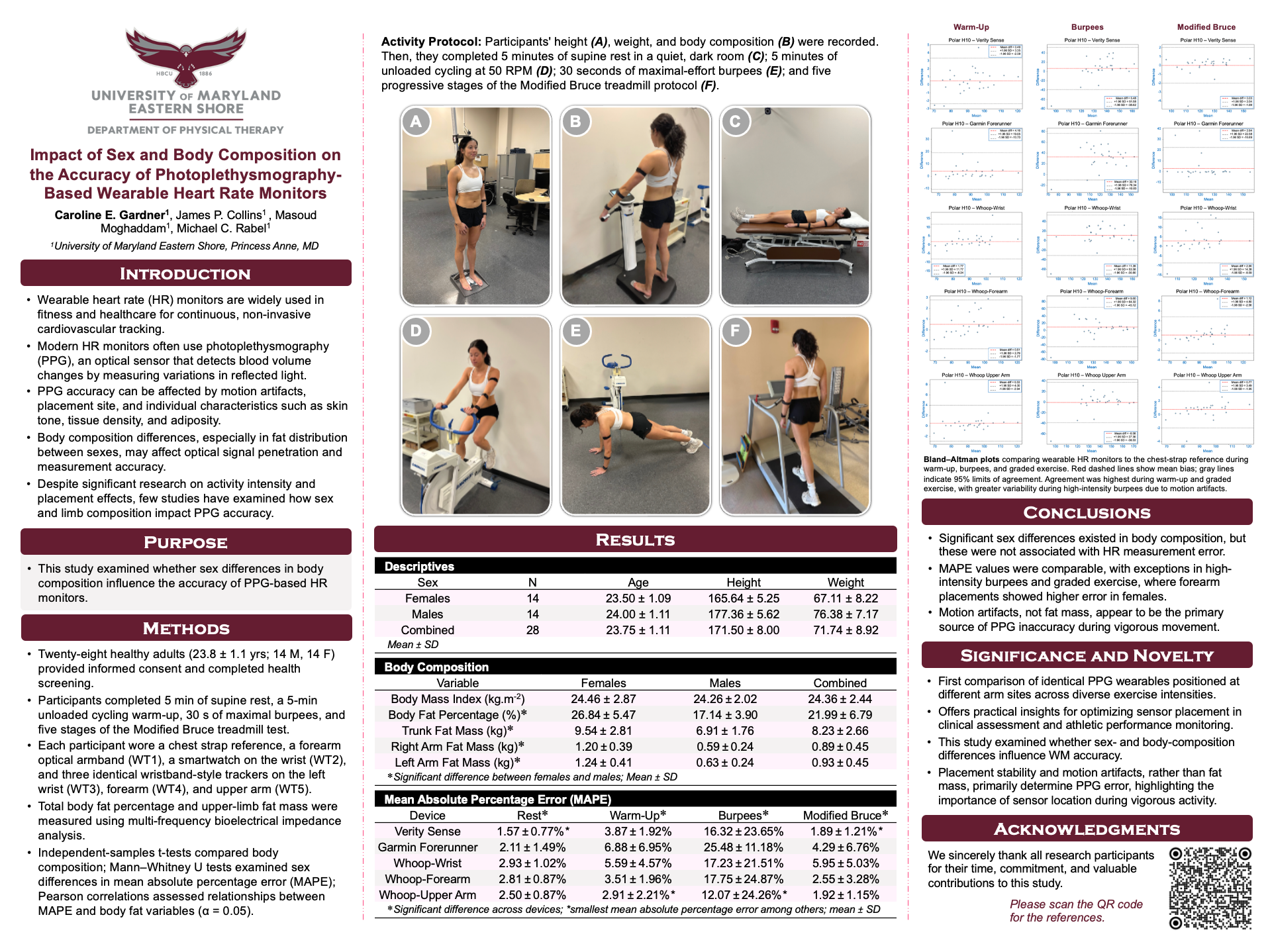
METHODS: Twenty-eight healthy adults (H: 171.5 ± 8.0 cm; W: 71.7 ± 8.9 kg;14 M, 14 F) completed four activity phases: 5-min supine rest, 5-min unloaded cycling warm-up, 30-s maximal burpees, and graded exercise. Participants wore five PPG-based wearable monitors (two wrist, two forearm, one left upper arm) while a validated chest strap was used as the reference to assess mean absolute percentage error (MAPE). Body fat percentage and upper-limb fat mass were assessed using multi-frequency bioelectrical impedance. Independent-samples t-tests compared body composition, Mann–Whitney U tests examined sex differences in MAPE, and Pearson correlations assessed associations with body fat variables.
RESULTS: T-tests showed significantly higher body fat for females (26.8 ± 5.5%) than males (17.1 ± 3.9%), t(26) = 5.41, p < .05; higher right arm fat mass (F: 1.20 ± 0.39 kg vs. M: 0.59 ± 0.11 kg), t(26) = 4.99, p < .05; and higher left arm fat mass (F: 1.20 ± 0.41 kg vs. M: 0.63 ± 0.24 kg), t(26) = 4.78, p < .05. MAPE did not differ between sexes for most devices (p > .05). During burpees, right-forearm-WM error was higher in females (16.9 ± 9.0%) than males (15.7 ± 32.9%), p < .05, though male variability was greater, likely reflecting faster, higher-volume movement. During graded exercise, left-forearm-WM error was also higher in females (3.27 ± 4.51%) than males (1.82 ± 0.97%), p < .05. No other devices showed sex differences. Correlations revealed no significant relationships between MAPE and body fat percentage or arm fat mass (p > .05).
CONCLUSION: Although body composition differed significantly between sexes, these measures were not associated with error. MAPE values were comparable, with exceptions in high-intensity burpees and graded exercise, where forearm placements showed higher error in females. Findings suggest that motion artifacts from vigorous activity, rather than fat mass, drive PPG inaccuracy.
SIGNIFICANCE/NOVELTY: This study examined whether sex- and body-composition differences influence WM accuracy. Our findings indicated that placement stability and motion artifacts, rather than fat mass, primarily determine PPG error, highlighting the importance of sensor location during vigorous activity.